
the dawn rush
View Gallery
2 Photos
by Paula M. Bodah
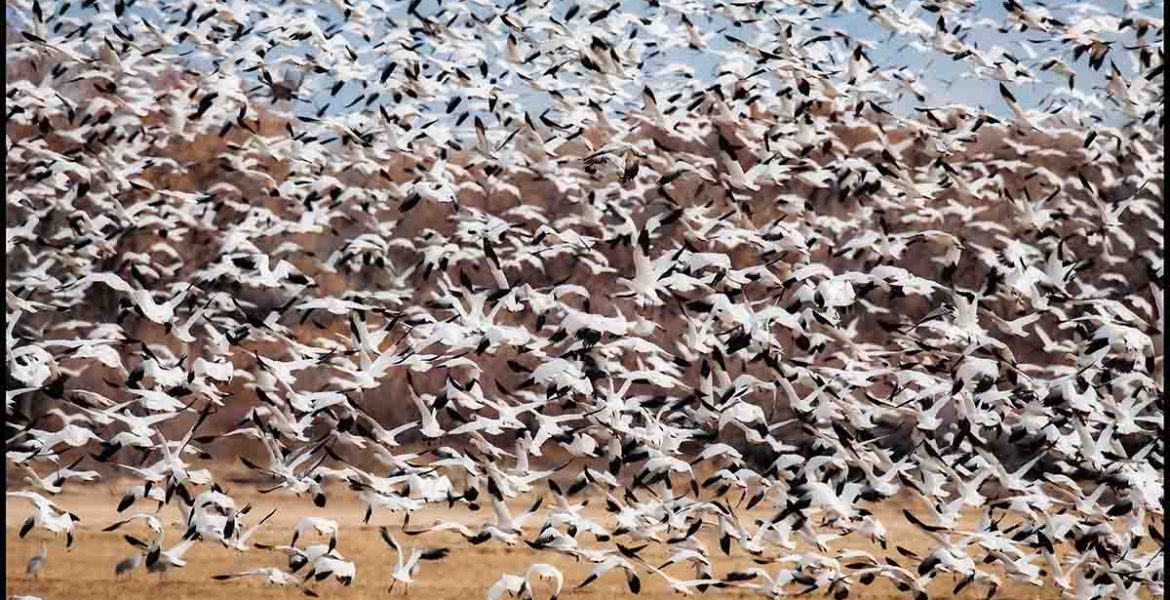
AT FIRST LIGHT, the wetlands seem almost still. Then, as if on cue, thousands of wings explode into the sky, and the air becomes alive with honks as the flock wheels overhead before streaming toward nearby fields to feed. It’s one of New Mexico’s most dramatic autumn displays, and one that’s surprisingly easy to witness.
Beginning in late October, snow geese arrive in central New Mexico after breeding on Arctic tundra stretching from Alaska and Canada to Greenland. They spend the winter here before returning north in late winter, making the Rio Grande Valley an important stop along one of North America’s great migratory routes.
Around Albuquerque, birdwatchers can often spot snow geese at Valle de Oro National Wildlife Refuge in the South Valley. Winter sightings are also possible along the Rio Grande bosque, at the Rio Grande Nature Center State Park, Los Poblanos Fields Open Space, Isleta Lakes and even Balloon Fiesta Park. For reliable viewing, however, head about an hour south to Bernardo Wildlife Area, where snow geese and elegant sandhill cranes gather in impressive numbers.
For the largest concentrations—and the unforgettable dawn lift-offs that have made New Mexico a favorite destination for birders—continue south to Bosque del Apache National Wildlife Refuge near Socorro. The birds spend the night on open water, where they’re safer from predators, then head to nearby harvested fields each morning to feast on leftover grain before returning to the wetlands by evening.
Despite their name, not all snow geese are snowy white. Most are, with distinctive black wing tips that flash in flight, but some wear bluish-gray plumage with white heads. These “blue geese” aren’t a separate species, just a different color morph of the same bird, adding even more visual interest to a passing flock. If you’re lucky enough to see one up close, look for the pink bill marked with a distinctive black “grin patch,” as though the bird is wearing a permanent smile.
The spectacle isn’t just visual. Thousands of geese call constantly to one another, creating a rolling chorus of honks that carries across the wetlands long before the flock comes into view. Meanwhile, New Mexico’s managed wetlands and nearby agricultural fields provide exactly what the birds need to refuel before making the long journey north again in February.
You don’t have to know a snow goose from a sandhill crane to appreciate the experience. On a crisp fall morning, as thousands of birds suddenly lift into a brilliant New Mexico sky, the sound and motion are enough to stop almost anyone in their tracks.
| Cookie | Duration | Description |
|---|---|---|
| __gads | 1 year 24 days | The __gads cookie, set by Google, is stored under DoubleClick domain and tracks the number of times users see an advert, measures the success of the campaign and calculates its revenue. This cookie can only be read from the domain they are set on and will not track any data while browsing through other sites. |
| _ga | 2 years | The _ga cookie, installed by Google Analytics, calculates visitor, session and campaign data and also keeps track of site usage for the site's analytics report. The cookie stores information anonymously and assigns a randomly generated number to recognize unique visitors. |
| _gat_gtag_UA_4680668_1 | 1 minute | Set by Google to distinguish users. |
| _gid | 1 day | Installed by Google Analytics, _gid cookie stores information on how visitors use a website, while also creating an analytics report of the website's performance. Some of the data that are collected include the number of visitors, their source, and the pages they visit anonymously. |
| CONSENT | 2 years | YouTube sets this cookie via embedded youtube-videos and registers anonymous statistical data. |
| iutk | 5 months 27 days | This cookie is used by Issuu analytic system to gather information regarding visitor activity on Issuu products. |
| Cookie | Duration | Description |
|---|---|---|
| IDE | 1 year 24 days | Google DoubleClick IDE cookies are used to store information about how the user uses the website to present them with relevant ads and according to the user profile. |
| test_cookie | 15 minutes | The test_cookie is set by doubleclick.net and is used to determine if the user's browser supports cookies. |
| VISITOR_INFO1_LIVE | 5 months 27 days | A cookie set by YouTube to measure bandwidth that determines whether the user gets the new or old player interface. |
| YSC | session | YSC cookie is set by Youtube and is used to track the views of embedded videos on Youtube pages. |
| Cookie | Duration | Description |
|---|---|---|
| __gpi | 1 year 24 days | No description |


