by Paula M. Bodah
the right tree, thoughtfully placed, can shade the house, cool the landscape and thrive with surprisingly little water
PLANTING A TREE in New Mexico calls for more forethought than simply falling for a pretty specimen at the nursery. In a climate where water is precious and summer heat continues to intensify, a well-chosen tree should earn its keep, casting welcome shade without demanding more irrigation than the landscape can reasonably support.
Trees moderate heat in more ways than one. Direct shade can lower temperatures along walls, windows and outdoor living areas, but the benefit extends beyond the canopy’s shadow. Through transpiration, trees release water vapor from their leaves, helping cool the surrounding air. Even a tree that isn’t positioned to shade the patio or house directly can contribute to a more comfortable landscape.
Start by deciding what you want the tree to accomplish. If shade is the priority, mature size and canopy spread matter just as much as drought tolerance. A small ornamental may cool a patio but never grow tall enough to shade a large house. Of course, there are tradeoffs. Homeowners routinely ask for a tree that is fast-growing, drought-tolerant and tidy. “The only tree I know of that fits that description is a cell tower,” jokes Camille Romero Melton, a certified arborist and diagnostician at Baca’s Trees.
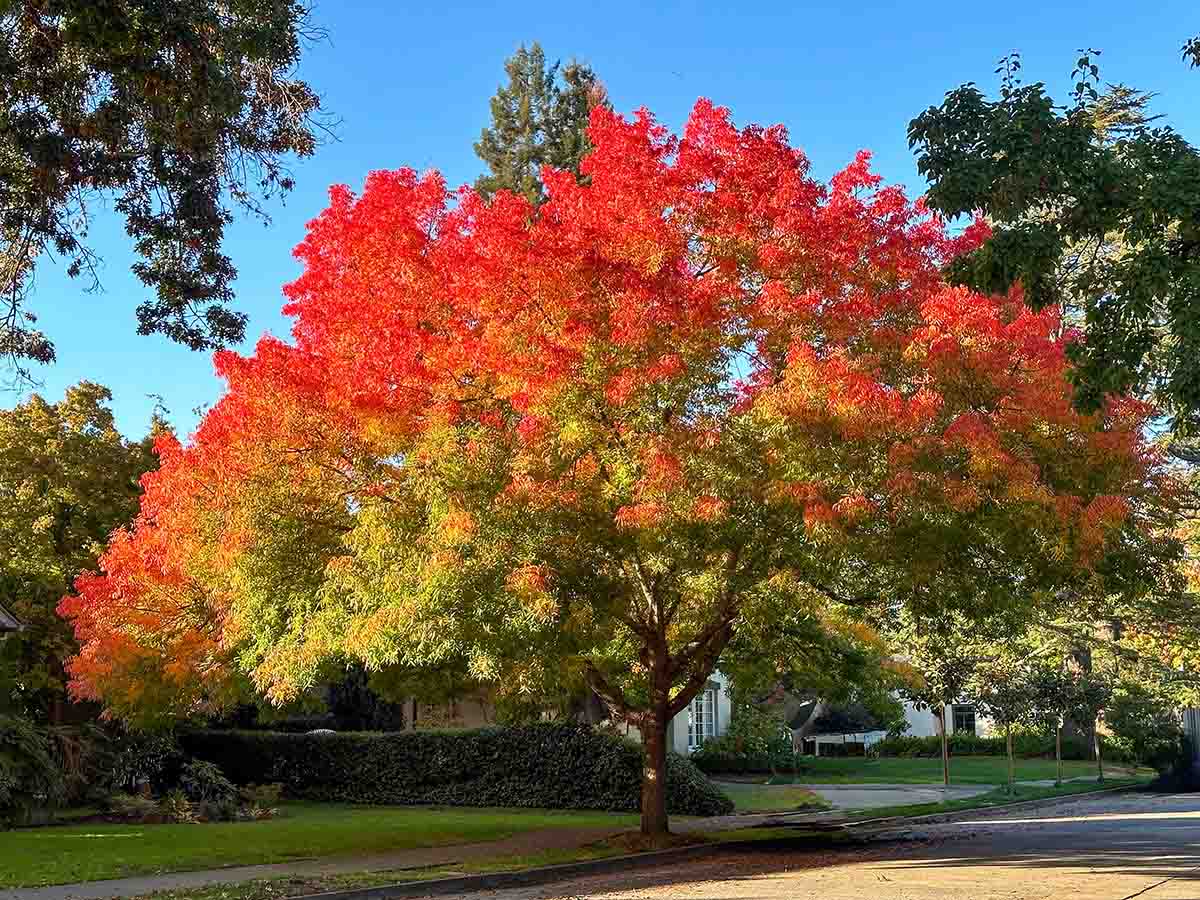
For substantial deciduous shade, newer elm species and cultivars are among Romero Melton’s favorites. Unlike the prolific-seeding Chinese elms familiar throughout Albuquerque, newer hybrids offer toughness and generous shade without the same profusion of seeds. Lacebark elm introduces beautifully mottled bark, while Frontier and Emerald Sunshine show off with vivid fall color. Romero Melton considers elms especially efficient choices for shade and drought tolerance.
Where space is modest, Chinese pistache is an appealing alternative. It develops a rounded canopy, produces brilliant fall color and uses less water than many deciduous trees. Depending on conditions, Chinese pistache can reach roughly 30 to 40 feet in height with a similar spread. Its relatively well-behaved roots make it a candidate for locations near patios and walls, although its slow growth means homeowners looking for quick shade may want to start with a larger specimen.
For smaller spaces and lower water use, vitex—which remains relatively compact—offers flowers in shades of white, pink and lilac, a graceful multi-trunk shape and plenty of appeal for pollinators. For an even leaner water budget, consider a desert willow. Once established, it can survive largely on rainfall. It grows at a moderate pace, although comparatively weak wood makes it more susceptible to storm damage.
Evergreens combine shade with screening and year-round structure. Native piñon pine is a low-water choice for smaller yards, although it grows slowly. Austrian pine can reach about 40 feet tall and 20 to 30 feet wide, making it better suited to larger properties where shade and privacy are priorities.
Where you plant a tree matters just as much as the tree you choose. West-facing walls and windows take the brunt of New Mexico’s afternoon sun, making them prime candidates for shade; south-facing windows can also benefit. Microclimates matter, too: The west side of a house is considerably hotter than the east.
“The biggest mistake I see is that people buy a tree when it’s small without thinking about how big it will be when it’s mature,” says Jon Wilson, director of construction and landscape architecture at Leeco Grounds Management. A tree that seems perfectly scaled at planting can eventually crowd a wall, patio or neighboring tree.
Plan for water before the tree ever goes into the ground. Newly planted trees need regular deep irrigation while roots become established; drought tolerance comes later. Bubblers or properly sized drip emitters should deliver water deeply rather than frequently wetting only the surface.
And in New Mexico, a few thousand feet of elevation can change the equation entirely. Santa Fe runs colder than Albuquerque, making cold hardiness an additional consideration for trees such as Chinese pistache and desert willow. Check the USDA hardiness zone for the specific site before buying. What begins as a modest nursery tree can, in time, become part of the home’s architecture—a living canopy that tempers summer afternoons for decades.
resources
Baca’s Trees
Leeco Grounds Management
lgmco.com