by Heather Shoning
how your home can help you build better habits
CREATING THE LIFE YOU LONG FOR begins at home—not just in theory, but in the small, sunlit corners of your space, in the quiet drawers and familiar routines where your habits are born. We rarely achieve change through sheer grit alone. More often, it tiptoes in through intentional design, shaped by what surrounds us. A thoughtfully arranged room can whisper encouragement. A well-placed object can nudge us toward the best version of ourselves. In a world that spins fast and pulls at our attention, our homes become sanctuaries of purpose—if we design them with intention.
Consider the desire to read more. It sounds lovely in theory, but without a welcoming invitation from your space, that stack of untouched novels becomes just another good intention gathering dust. Instead, imagine a plush chair tucked into a quiet corner of your home. Beside it, a side table holds a book, waiting to be opened again. The invitation is clear. No friction, no planning—just a space that beckons you to slow down and slip into a new routine.
Perhaps you long for a daily gratitude practice. We often resolve to reflect, to pause, to count blessings—but when the journal is stashed away in a drawer, the practice evaporates. Instead, imagine how a beautiful notebook on a wooden tray atop your nightstand—its pages open to yesterday’s thoughts—makes it easier to embrace this new habit. You don’t have to remember to be grateful; your space does the remembering for you.
Even the way we nourish ourselves can be transformed by subtle shifts in how we see—and store—what we eat. We don’t make our best food choices when we’re famished and rummaging through a chaotic refrigerator. But if you open the fridge and are immediately greeted by a row of glistening glass containers filled with jewel-toned berries, crisp carrot sticks or vibrant citrus wedges, you’re far more likely to reach for something fresh. The produce drawer becomes less of a graveyard and more of a gallery, beautifully curated and effortlessly accessible. It’s nourishment by design—simple, smart and quietly inspiring a healthy lifestyle.
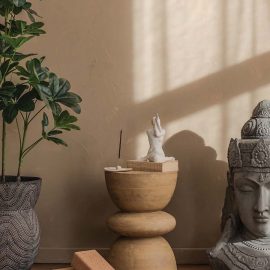
In the pursuit of mindfulness, we often imagine we need an entire room, a retreat, a total reset, allowing the overwhelm to stand in the way of transformation. But serenity doesn’t require square footage. It just requires intention. Claim a corner of your bedroom, softened with a plush rug or yoga mat, maybe a woven basket holding a folded blanket and other meditation requisites. Don’t forget a small speaker to play gentle music or the familiar cadence of a guided meditation. Here, the world slows. You sit—not because you should, but because you want to. You’ve created a little shrine to stillness, and in doing so, you’ve made mindfulness feel like a gift, not a chore.
And then there are the more practical habits—the ones that don’t always make Instagram but do make life infinitely smoother. Mornings, for instance, have a way of unraveling before we’ve even had coffee. But what if the rush was replaced with rhythm? When your bathroom counter is no longer cluttered and instead has a curated tray with only the essentials: morning skincare, a few favorite products, a brush laid neatly in place, prepping for the day is calm. Plus, your keys and sunglasses already waiting in the same pretty bowl by the door where they always are. There’s no frantic last-minute search, no chaos—just a gentle glide into your day.
Even cleaning—that eternally postponed task—becomes effortless with the right cues. Incorporate a charming little caddy in the cabinet beneath your bathroom sink, perfectly stocked with a gentle cleaner, a soft cloth and maybe even a spritz that smells like eucalyptus or lemon verbena. You notice a toothpaste splatter on the mirror and—without thinking—you wipe it away. Not because it’s cleaning day, but because the design supports the action.
What all these gestures have in common is not extravagance, but thoughtfulness. You’re no longer forcing better habits through sheer will. You’re designing a life where those habits feel inevitable. Because in the end, home isn’t just a collection of rooms and furniture. It’s a living reflection of your priorities, your rhythms, your desires. When we begin to see our spaces not as static backdrops but as active partners in our wellbeing, everything shifts.