autumn ambling

View Gallery
2 Photos
by Lexi Marshall
a scenic journey through the Great Smoky Mountains
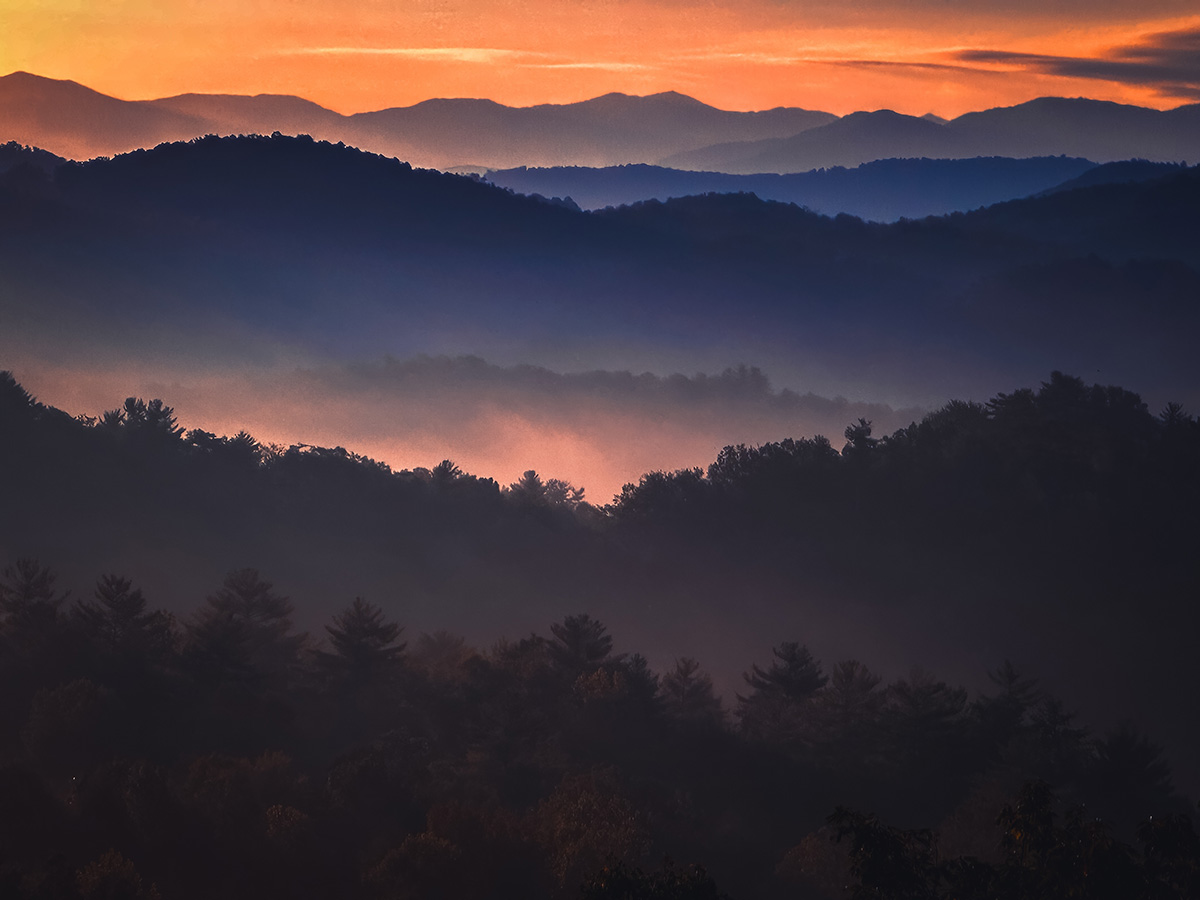
STRADDLING THE BORDER of North Carolina and Tennessee, the Great Smoky Mountains offer one of the most spectacular autumn displays in the country. With their ancient ridgelines, vibrant deciduous forests and historic byways, the Smokies transform into a blaze of color each fall, drawing millions of visitors eager to witness the natural spectacle.
The peak season for fall foliage in the park’s mid to lower elevations typically spans mid-October through early November. During this time, trees like sugar maple, scarlet oak, sweetgum, r ed maple and hickories reach their most brilliant hues, painting the landscape in deep reds, bright oranges and golden yellows. With more than 100 native tree species in the park, the diversity of color is unmatched in the eastern United States.
Diversity is not just limited to trees here, either. Wildlife is abundant. You might spot deer, elk, black bears, Northern flying squirrels—yes, flying—, wild turkey, Eastern screech owls and more. Broadwing hawks are said to put on a show her e during their autumn migration—sometimes hundreds or even thousands of them soaring along ridgelines. Additionally, the Great Smoky Mountains area has been dubbed “The Salamander Capital of the World.” It is the only home of the Jordan’s Salamander, which is found nowhere else in the world except in the high peaks of the Smokies.
Scenic Drives Through the Smokies
One of the most rewarding ways to take in the scenery is from the comfort of your car. The Smoky Mountains are home to several designated scenic byways and mountain roads that offer panoramic views, roadside overlooks and access to historical landmarks.
Newfound Gap Road (U.S. 441) is among the most popular routes through the park. Stretching 33 miles from Gatlinburg, Tennessee, to Cherokee, North Carolina, the drive crosses Newfound Gap at an elevation of 5,046 feet and offers sweeping views of layered mountain ridges. Along the way, visitors can stop at the Newfound Gap Overlook—site of President Franklin D. Roosevelt’s 1940 dedication of the national park—and Clingmans Dome Road, which leads to the highest point in the Smokies at 6,643 feet. The half-mile paved walk to the Clingmans Dome observation tower is steep, but the 360-degree view is well worth the effort on a clear day.
Cades Cove Loop Road provides a slower, more immersive experience. This one-way, 11-mile loop circles a broad, verdant valley surrounded by mountains and is dotted with historic cabins, churches and a gristmill. The cove is not only rich in cultural history but also offers a good chance of spotting wildlife, particularly in the early morning or evening.
Another less-trafficked route, Roaring Fork Motor Nature Trail, is a narrow, winding 5.5-mile loop that begins in Gatlinburg. The road follows a mountain stream past dense forest, waterfalls and log cabins. It’s especially picturesque in fall, with leaves carpeting the forest floor.
Notable Stops + Historic Highlights
The Great Smoky Mountains National Park is also a stronghold of Southern Appalachian history. The Mountain Farm Museum, located near the park’s Oconaluftee Visitor Center in North Carolina, showcases a collection of 19thcentury buildings—including a log farmhouse, barn, apple house and blacksmith shop—relocated from different parts of the park. The museum offers a glimpse into early mountain life and is open year-round.
For those interested in Indigenous history, the Museum of the Cherokee People in Cherokee, North Carolina, provides context about the original inhabitants of these mountains, notably the Eastern Band of Cherokee Indians, whose ancestral lands encompass much of the southern Smokies. Established in 1948, the museum is one of the longest-operating tribal museums in the country.
Preserving the View
Designated a UNESCO World Heritage Site and an International Biosphere Reserve, the Great Smoky Mountains National Park protects more than 500,000 acres of temperate forest. It is consistently the most-visited national park in the U.S., and the fall season is among its busiest. To avoid crowds, consider visiting on weekdays and starting drives early in the morning.
From the vibrant foliage to the quiet creak of old wooden floors, abundant wildlife to living history, autumn in the Smokies is more than a visual feast—it’s a rich story of nature and culture around every turn.
| Cookie | Duration | Description |
|---|---|---|
| __gads | 1 year 24 days | The __gads cookie, set by Google, is stored under DoubleClick domain and tracks the number of times users see an advert, measures the success of the campaign and calculates its revenue. This cookie can only be read from the domain they are set on and will not track any data while browsing through other sites. |
| _ga | 2 years | The _ga cookie, installed by Google Analytics, calculates visitor, session and campaign data and also keeps track of site usage for the site's analytics report. The cookie stores information anonymously and assigns a randomly generated number to recognize unique visitors. |
| _gat_gtag_UA_4680668_1 | 1 minute | Set by Google to distinguish users. |
| _gid | 1 day | Installed by Google Analytics, _gid cookie stores information on how visitors use a website, while also creating an analytics report of the website's performance. Some of the data that are collected include the number of visitors, their source, and the pages they visit anonymously. |
| CONSENT | 2 years | YouTube sets this cookie via embedded youtube-videos and registers anonymous statistical data. |
| iutk | 5 months 27 days | This cookie is used by Issuu analytic system to gather information regarding visitor activity on Issuu products. |
| Cookie | Duration | Description |
|---|---|---|
| IDE | 1 year 24 days | Google DoubleClick IDE cookies are used to store information about how the user uses the website to present them with relevant ads and according to the user profile. |
| test_cookie | 15 minutes | The test_cookie is set by doubleclick.net and is used to determine if the user's browser supports cookies. |
| VISITOR_INFO1_LIVE | 5 months 27 days | A cookie set by YouTube to measure bandwidth that determines whether the user gets the new or old player interface. |
| YSC | session | YSC cookie is set by Youtube and is used to track the views of embedded videos on Youtube pages. |
| Cookie | Duration | Description |
|---|---|---|
| __gpi | 1 year 24 days | No description |