by Paula M. Bodah
a makeover for your interior staircase can give your home a refresh
GRAND AND TRADITIONAL, sleek and contemporary, or somewhere in between, the interior staircase sets a home’s tone and reflects the style of the people who live there. But what happens when a homeowner craves a change in style? While it’s easy enough to switch up wall colors or swap out furniture, giving a stairway a new look might seem a bit more daunting.
Mark Vigil, general manager of Albuquerque Stair, says it’s not uncommon for his company to hear from homeowners who want to revamp their stairs as part of a home redecorating project. “Within the last five years, the style has become more modern and contemporary,” he says. “A while back, the decorative Tuscan look was popular, but now people want something more streamlined, cleaner.”
At the simplest end of the spectrum, consider painting your stairway for a new look. A traditional oak banister and railing take on a more graphic, contemporary look with a coating of matte black paint.
Taking things a bit further, replacing ornate balusters and newel posts with plainer elements can make a big difference. “Sometimes, all you need is someone to guide you with ideas for a simpler baluster pattern,” Vigil says.
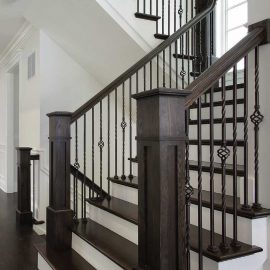
Owners of a traditional-style home with wooden moldings or wainscoting might want to stick with a wooden banister atop wood balusters. Still, he suggests replacing a wooden railing with iron for a fresh look. “You can choose something with a more traditional shape and pattern,” he says. “We’ve replaced wooden spindles with iron, and, boy, the customer just loves it! It can be a game changer.”
If an all-iron stairway feels too contemporary, iron balusters with wooden newel posts and handrail can straddle the line between classic and modern for a happy compromise. If metal isn’t your thing, a wooden railing can be replaced with glass for an open look with a less industrial feel.
If it’s possible, removing a wall or two to open the stairway can also lend a more modern feel. If you’re thinking about that, Vigil recommends enlisting a contractor to ensure your staircase isn’t closed in by load-bearing walls. “In a couple of scenarios we’ve dealt with, we’ve had to put in a beam and structurally reframe things so we could get rid of a load-bearing wall,” he explains. “It takes a little more remodeling and a contractor to make sure it works and is safe.” Consider enlisting the help of a structural engineer for complicated projects.
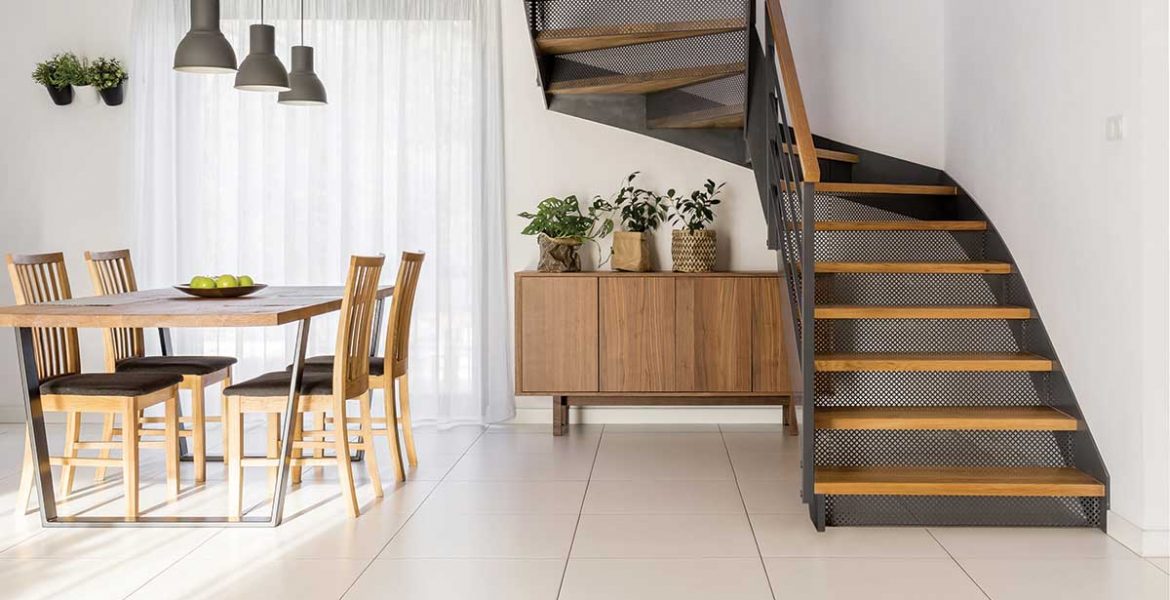
Damian Pascetti, owner of Pascetti Steel in Albuquerque, describes a home where the wooden stairway was surrounded on the first floor by a rounded adobe wall. A contractor took out the wall and the old stairs. Then, Pascetti explains, “We replaced the old wooden stair with a self-supporting steel stair. It opened the house dramatically, taking it from a 1980s Southwestern feel to a 2020s open, contemporary, transparent look.”
The self-supporting stairway Pascetti describes is also called a “floating” staircase because it appears almost to hover in place. For an even airier effect, horizontal rails might be used instead of traditional vertical balusters, and risers are dispensed with entirely.
Although Pascetti says most of his stair fabrication is for new homes, replacing an existing stair with an all-steel one is doable, especially if the footprint of the stair and landings remains the same. “It’s really a case-by-case thing, and it depends on your timeframe and budget,” he says.
No matter how you choose to revamp your stairs, Vigil is firm in his recommendation that you stick with wooden treads. “Some people like carpet because they have a dog or because they have little children, but a carpet only lasts so long,” he says. “I would always point people in the direction of a hardwood tread because they’re durable. If you put three coats of polyurethane, they should be good for years.”
From a simple railing swap to an all-out replacement, your stairway can stay in tune with your own evolving style.
resources
Albuquerque Stair
Pascetti Steel