by Amy Gross
one crazy cool head-banger
WE ALL HAVE OUR FAVORITE BIRDS—the ones that make us smile every time we see or hear them. I have a soft spot for woodpeckers, those crazy, gravity-defying, bug-huntin’ head-bangers. The aptly named ladder-backed woodpecker is probably New Mexico’s most common woodpecker, as it prefers dry, desert habitats. And in my opinion, it’s one of the coolest.
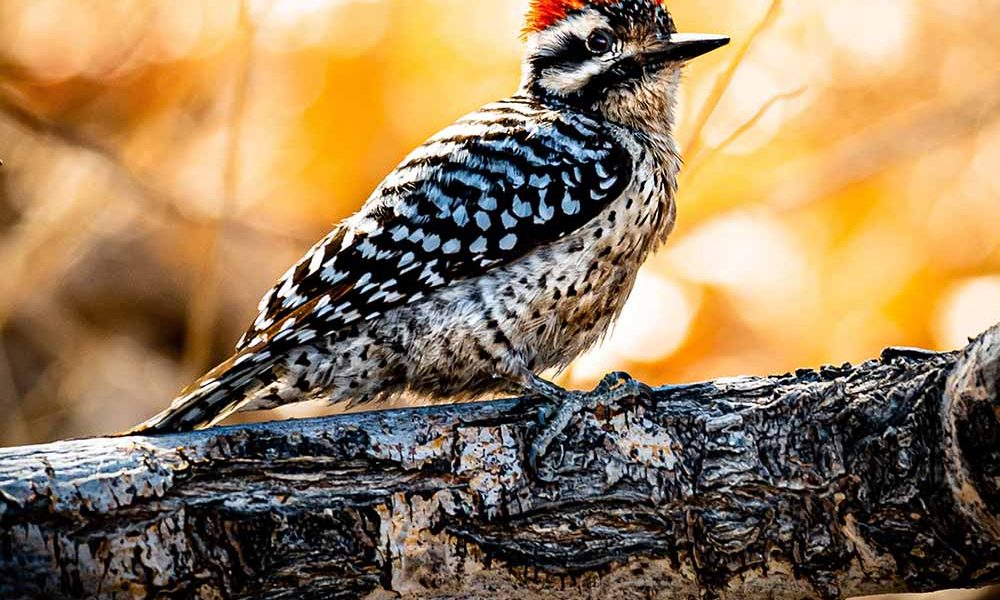
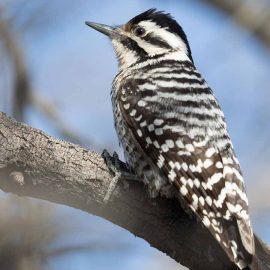
The ladder-backed woodpecker (let’s call it an LBW since the name is such a mouthful) is a small member of the species, between 6 and 7 inches long. Its four toes are arranged in an X pattern so that two toes grip upward and two downward as the LBW navigates tree trunks, branches and cactus spines in any number of upside, downside and sideways positions in search of insects and larvae. A long, sturdy tail helps to support the body during these acrobatics. It earns its name from the beautiful “ladder” of stripes and speckles on the back and wings. The sexes ar e identical except for the head; the male has a crown of bright red, while the female’s is black.
Despite their showy appearance, LBWs can be hard to spot because those speckles help them to camouflage. Plus, they move so darn quickly, zipping around tree trunks and branches faster than the eye can follow. So, how can you tell a ladder-backed is near? You could listen for the telltale drumming of a beak against wood and follow that sound. Or listen for the LBW’s distinctive call, which often announces the bird’s intention to relocate. Imagine you’re out for a morning walk. Suddenly you hear this: Chip! Chip! [maniacal giggle!]
Then, a little figure zips past you and makes a beeline directly for a nearby tree. If you can follow this bird with your eyes, you’ll notice it doesn’t gently alight upon a branch in typical birdlike fashion. Instead, it fastens itself to a tree trunk as though it were being magnetized to it, fully upright. Classic woodpecker behavior!
I see lots of woodpeckers in the fall (the gorgeous Northern flickers will be coming in soon), but the LBW is the one I most often see at my feeders. They love suet and dried mealworms and eat some seed, too. Try all of these in “cylinder” form and hang them where you can keep watch for a funny, speckled acrobat on a perpetual mission for something yummy to eat.
Amy Gross is a birder and the organizer of Santa Fe Birdbrains, a Northern New Mexico–based Meetup group.